Today's date is May 31, 2026.
AI Strategy Blueprint
ACME Corp — Automated MEDPICK Account Planning System
Prepared for John Hanby, Chief Revenue Officer
Table of Contents
- Executive Summary
- Current State Assessment
- Solution Architecture
- Technology & Model Selection
- Cost Model & Investment Analysis
- Deployment Plan & Phased Roadmap
- Organizational Readiness & Training
- Stakeholder Alignment & Governance
- Risk Assessment & Mitigation
- Executive Recommendations & Next Steps
1. Executive Summary
The Opportunity
ACME Corp's sales team of 7 representatives currently spends 4-5 hours per account manually researching and assembling account plans across LinkedIn, ZoomInfo, Apollo, company websites, public filings, news sources, and analyst research. The process is inconsistent, largely undocumented, and frequently skipped entirely — resulting in lost pipeline velocity, misallocated selling capacity, and zero management visibility into account preparation quality.
The Proposed Solution
An AI-powered automated account planning system that transforms a simple URL input into a comprehensive, standardized MEDPICK account plan — synthesizing data from 7 external sources, populating 30 structured data points, matching accounts to ACME Corp's 20-product catalog, and delivering a professional PDF via email within 10-15 minutes. The system processes up to 100 net-new account plans per day and stores all results in Salesforce for centralized visibility.
Key Findings
| Dimension | Assessment |
|---|
| Complexity Score | 65/100 — High Complexity |
| Recommended Solution | Hybrid: Auto Reports Cloud (Phase 1) with On-Prem Migration Path (Phase 2) |
| Viability Status | Viable — No critical gaps identified; 2 medium-severity items require attention |
| Estimated Annual Value | $500,000 (conservative; $750,000+ with win-rate uplift) |
| Year 1 Investment | $266,000 - $392,000 (scenario-dependent) |
| Payback Period | 9.2 months (base scenario) |
| Year 3 ROI | 116.5% cumulative |
Strategic Recommendation
Deploy a cloud-first Auto Reports pilot within 30 days, starting with 3-4 core data sources and scaling to the full 7-source pipeline over 60-90 days. This approach minimizes upfront capital expenditure, validates ROI before board-level commitment, and preserves the option to migrate to on-premise infrastructure if volume and cost analysis justify it.
2. Current State Assessment
2.1 Workflow Pain Points
The current manual account planning process suffers from five interconnected failures:
| Pain Point | Impact | Quantified Cost |
|---|
| Excessive time consumption | 4-5 hours per account plan; 7 reps x 6-8 hours/week on research | $218,000 - $312,000/year in rep time |
| Inconsistent quality | Each rep produces different-quality Word documents with varying depth | Unquantified win-rate impact |
| Zero visibility | Management cannot verify whether account planning is being done | Pipeline risk exposure |
| Low adoption | Most reps skip account planning entirely due to friction | $200,000 - $400,000/year in misallocated capacity |
| No institutional memory | Plans are not centralized; knowledge leaves when reps leave | Recurring onboarding cost |
2.2 AI Maturity Assessment
ACME Corp is at the Exploring stage of AI maturity. The team has experimented with ChatGPT for ad-hoc tasks but reports dissatisfaction with the results and has no structured AI implementation in production. This is a common starting position for organizations of this size and does not present a barrier to implementation — it does, however, underscore the need for professional prompt engineering and structured change management rather than a self-service approach.
2.3 Data Landscape
| Characteristic | Assessment |
|---|
| Data Sensitivity | Internal — all source data is publicly available; no PII, PHI, or classified information |
| Compliance Requirements | None identified — no HIPAA, SOC 2, CMMC, or GDPR obligations |
| Data Sources | 7 external sources (LinkedIn, ZoomInfo, Apollo, company websites, SEC filings, news/press, Gartner/IDC/Forrester) |
| Data Volume | 100 net-new account plans per day |
| Security Posture | Standard enterprise security practices requested; no regulatory constraints |
3. Solution Architecture
3.1 Architecture Overview
The recommended architecture is a cloud-hosted agentic pipeline that orchestrates real-time data aggregation from 7 external sources, synthesizes the results through a frontier LLM into a structured MEDPICK framework, performs product-to-account matching, and delivers a formatted PDF via email with Salesforce record creation.
Important Architectural Note: This is NOT a standard document processing or retrieval-augmented generation (RAG) use case. No existing document corpus needs to be ingested. No vector store is required. The system generates net-new content from real-time API data. The packaged AI product (Auto Reports) handles the LLM reasoning and synthesis layer, while significant custom engineering is required for the API orchestration, PDF generation, email delivery, and CRM integration layers.
3.2 System Architecture Diagram
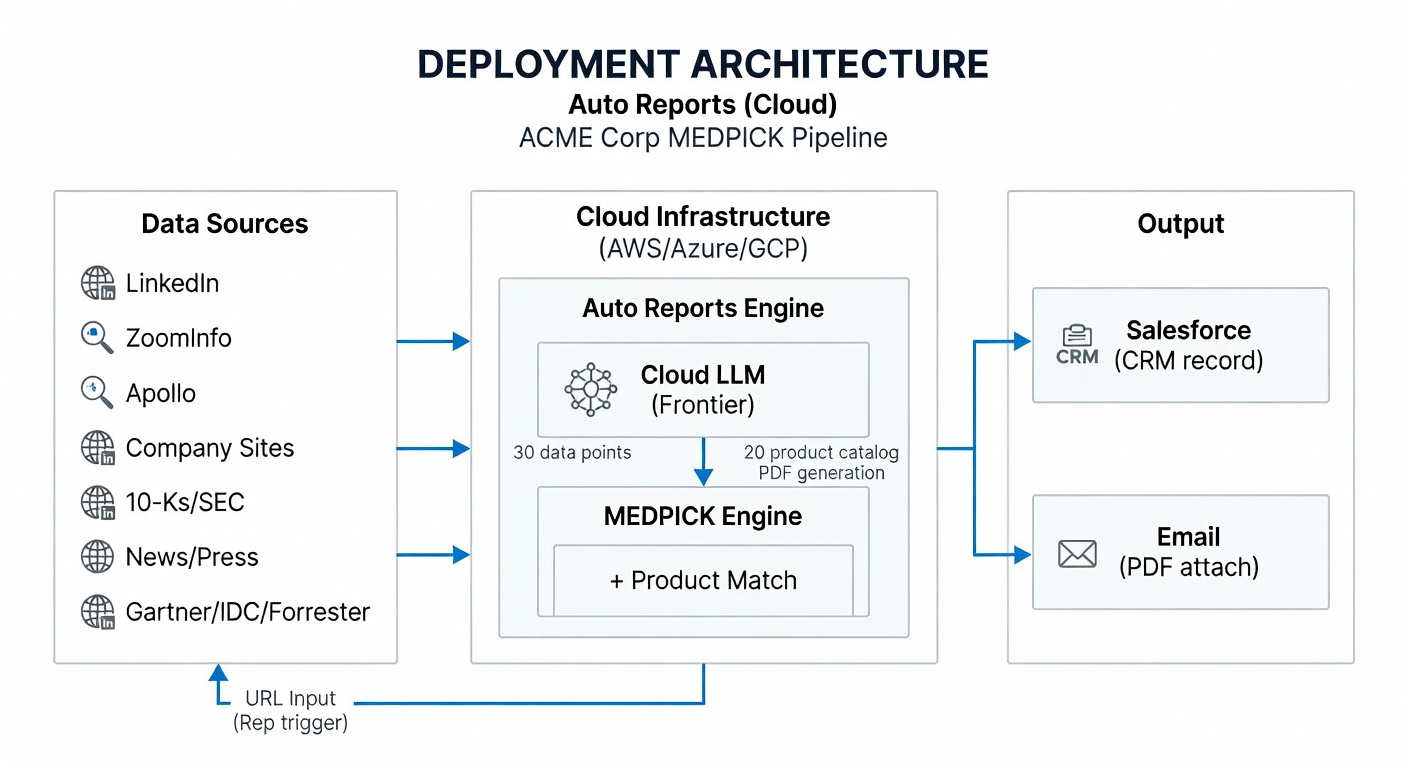
3.3 Complexity Scoring Breakdown
The solution received a total complexity score of 65/100 (High Complexity), driven by three primary factors:
| Component | Score | Description |
|---|
| Base Complexity (Report Automation) | 40 | Multi-source data aggregation, MEDPICK synthesis, product matching, PDF output |
| Integration Complexity (7 data sources) | 20 | Extensive API development and data mapping across LinkedIn, ZoomInfo, Apollo, company websites, SEC filings, news, analyst research |
| Data Sensitivity (Internal) | 5 | Standard enterprise security practices for storage and transmission |
| Scale Modifier | 0 | User count of ~50 is within the small-scale threshold |
| Document Complexity | 0 | No PDF ingestion pipeline required |
| Processing Requirements | 0 | No critical accuracy thresholds or real-time latency requirements |
| Timeline-Maturity Mismatch | 0 | Exploring maturity does not trigger mismatch with 30-day timeline |
| Total | 65 | High Complexity |
Favorable Factors: Despite the high complexity score, the architecture benefits from several simplifying conditions: no PDF ingestion pipeline, no critical accuracy thresholds, no real-time latency requirements, a small user base (50 or fewer), and no compliance constraints. The complexity is concentrated in the integration layer, which can be addressed through phased data source onboarding.
3.4 Solution Pattern Analysis
| Product | Score | Rationale |
|---|
| Auto Reports (On-Prem) | 90/100 | Highest score — centralized batch processing, standardized output, strong centralization alignment |
| Auto Reports (Cloud) | 85/100 | Near-identical — faster deployment, lower upfront cost, cloud simplicity bonus |
| AirGap AI | 0/100 | Fundamentally misaligned — per-device local processing cannot support centralized batch pipeline with 7-source API orchestration |
The 5-point differential between on-prem (90) and cloud (85) reflects a genuine architectural trade-off rather than a clear winner. Both platforms handle the core requirement — centralized bulk processing of 100 standardized MEDPICK account plans per day. The recommendation to start with cloud is driven by ACME Corp's startup profile, 30-day timeline, absence of existing data center infrastructure, and ROI-driven budget approach.
3.5 Blockify (RAG) Assessment
Verdict: Not Applicable
Blockify — Iternal Technologies' document ingestion and vectorization platform — has no role in this architecture. The MEDPICK account planning workflow is a real-time data aggregation and content generation pipeline, not a retrieval-augmented generation use case. There is no existing document corpus to ingest into a vector store, no semantic search or retrieval step, and no pre-indexed content being queried. All data is pulled in real-time from external APIs and synthesized into net-new output.
3.6 Integration Points
| System | Integration Type | Complexity | Notes |
|---|
| ZoomInfo | API — company and contact enrichment | Medium | Existing subscription; evaluate replacement potential during pilot |
| Apollo | API — contact and company intelligence | Medium | Evaluate overlap with ZoomInfo to reduce costs |
| LinkedIn | API or structured data extraction | High | Restricted API access; may require Sales Navigator API or third-party enrichment |
| SEC EDGAR | API — 10-K and financial filing retrieval | Medium | Free public API; requires document parsing for financial data extraction |
| News/Press | API — real-time news retrieval | Low | Multiple providers available (NewsAPI, Google News API) |
| Gartner/IDC/Forrester | API or content licensing | High | Restrictive content licensing; may require enterprise subscription with API access |
| Salesforce | API — write account plans as custom objects | Medium | REST API for record creation; custom object design for 30 MEDPICK data points |
| Email (PDF Delivery) | SMTP/API — automated PDF delivery | Low | SendGrid, AWS SES, or similar service |
4. Technology & Model Selection
4.1 Requirements Profile
| Dimension | Value | Derivation |
|---|
| Accuracy Level | Moderate | User wants gaps flagged rather than fabricated; not mission-critical accuracy |
| Reasoning Complexity | High | Multi-source analysis + MEDPICK synthesis + product matching across 20 products |
| Context Length Needed | ~55,000 tokens | Accumulated context across 7 API source calls plus system prompt |
| Speed Requirements | Fast | 10-15 minute turnaround target (near-real-time) |
| Cost Sensitivity | High | Startup, ROI-driven, interested in reducing ZoomInfo spend |
| Data Sensitivity | Internal | Cloud-viable; no data residency constraints |
4.2 Token Volume Estimation
This is an agentic content generation pipeline — not a standard document processing workflow. Each task involves multiple tool calls across an orchestrated pipeline with accumulated context.
| Metric | Per Task | Daily (100 tasks) | Monthly (22 days) | Annual |
|---|
| Input Tokens | 55,000 | 5,500,000 | 121,000,000 | 1,452,000,000 |
| Output Tokens | 15,000 | 1,500,000 | 33,000,000 | 396,000,000 |
| Total Tokens | 70,000 | 7,000,000 | 154,000,000 | 1,848,000,000 |
Volume Tier: Very High (~1.85 billion tokens annually)
Cost Optimization Note: Despite the very high token volume, prompt caching can reduce effective costs by 40-60% on the system prompt and product description components (~5,000 tokens repeated across all 100 daily tasks). Enterprise-tier pricing negotiations may also be warranted at this volume.
4.3 Recommended Models
Cloud Models (Recommended for Phase 1)
| Model | Input $/M | Output $/M | Context | Annual Cost (Base) | Annual Cost (Budgeted 1.85x) | Rationale |
|---|
| Google Gemini 3 Flash Preview (Primary) | $0.50 | $3.00 | 1M | $1,914 | $3,541 | Best cost-performance balance for high-volume agentic synthesis |
| OpenAI GPT-4o-mini (Fallback) | $0.15 | $0.60 | 128K | $455 | $842 | Ultra-low-cost alternative from different provider family |
| Google Gemini 2.5 Flash Lite | $0.10 | $0.40 | 1M | $304 | $562 | Absolute lowest cost; may sacrifice synthesis quality |
| MoonshotAI Kimi K2.6 | $0.68 | $3.42 | 262K | $2,342 | $4,332 | Mid-tier with strong reasoning |
| Anthropic Claude Sonnet 4.6 | $3.00 | $15.00 | 1M | $10,296 | $19,048 | Premium fallback for high-value accounts |
All recommended models support Zero Data Retention (ZDR) policies.
On-Premise Models (Phase 2 Migration Target)
| Model | Parameters | Context | Min Hardware | Est. Cost/M Tokens | Annual Infra Cost |
|---|
| Llama 3.1 70B (Primary) | 70B | 128K | Intel Gaudi 2 (8x) | $0.05 | $15,000 - $30,000 |
| Qwen 3.5 397B | 397B MoE | Large | NVIDIA H100 (8x) | $0.08 | $30,000 - $60,000 |
4.4 Self-Hosting Analysis
| Metric | Value |
|---|
| Daily token volume | 7,000,000 |
| Required throughput | 243 tokens/sec (316 tok/s with headroom) |
| Cloud monthly spend (Gemini 3 Flash) | ~$160/month |
| Self-hosting breakeven threshold | $12,000 - $19,000/month |
| Verdict | Cloud API is significantly more cost-effective at current volumes. Self-hosting only makes sense if data residency requirements emerge or volume scales 10x or more. |
5. Cost Model & Investment Analysis
5.1 Year 1 Investment Breakdown
One-Time Costs
| Component | Low | Midpoint | High | Basis |
|---|
| AI Engineering Services | $85,000 | $105,000 | $125,000 | High complexity; 7 data sources, custom MEDPICK schema, product matching logic |
| Systems Integration | $60,000 | $80,000 | $100,000 | 7 API integrations + Salesforce + email + PDF generation |
| Training | $22,500 | $41,250 | $60,000 | 50 users, high complexity multiplier (1.5x) |
| Subtotal One-Time | $167,500 | $226,250 | $285,000 |
Annual Recurring Costs
| Component | Low | Midpoint | High | Basis |
|---|
| Token/Inference (Cloud API) | $562 | $3,541 | $19,048 | Model-dependent; range from Gemini Flash Lite to Claude Sonnet 4.6 |
| Software Platform Licensing | $60,000 | $90,000 | $120,000 | Auto Reports for ~50 users |
| AI Engineering (Ongoing) | $28,000 | $37,000 | $45,000 | Quarterly prompt optimization, eval monitoring, template iteration |
| Systems Integration Maintenance | $8,000 | $10,000 | $12,000 | API version upgrades, connector updates, health monitoring |
| Cloud Infrastructure | $5,000 | $10,000 | $15,000 | Orchestration compute, storage, PDF generation |
| Support | $5,000 | $10,000 | $15,000 | Ongoing vendor support |
| Training Refresh | $3,000 | $5,000 | $8,000 | New-hire onboarding, feature updates |
| Subtotal Recurring | $109,562 | $165,541 | $234,048 |
Year 1 Total
| Low | Midpoint | High |
|---|
| Year 1 Total | $277,062 | $391,791 | $519,048 |
Software Licensing Note: Software platform licensing shown is a budgetary estimate based on the platform mix and anticipated user/document volume. Final licensing is confirmed through a scoping engagement with Iternal Technologies and may vary based on actual deployment size, contract term (1-year vs. multi-year), and platform combination.
Systems Integration Note: Systems integration is scoped and delivered by a qualified third-party implementation partner. Iternal Technologies will introduce a qualified partner; SI cost is scoped separately from Iternal's AI engineering services.
5.2 Three-Year Cost Projection
| Period | Cumulative Cost (Midpoint) |
|---|
| Year 1 | $391,791 |
| Year 2 | $557,332 |
| Year 3 | $692,873 |
5.3 Cost Comparison Scenarios
| Scenario | Year 1 | Annual Ongoing | Year 3 Total | Primary Model | Best For |
|---|
| Scenario 1: Cloud (Recommended) | $391,791 | $155,541 | $692,873 | Gemini 3 Flash Preview | Fastest deployment; aligns with 30-day target |
| Scenario 2: On-Prem | $406,291 | $174,541 | $755,373 | Llama 3.1 70B on Gaudi 2 | Long-term cost optimization; data on-premises |
| Scenario 3: Lean Cloud | $266,250 | $130,842 | $527,934 | GPT-4o-mini | Budget-optimized pilot; lower initial commitment |
ZoomInfo Offset Opportunity: ACME Corp expressed interest in reducing ZoomInfo spend to offset AI solution costs. ZoomInfo typically costs $15,000-$40,000/year for a team of 7 reps. If the AI pipeline can replicate ZoomInfo's core enrichment data from alternative public sources and lower-cost APIs, this could offset 10-25% of ongoing annual cost. This should be evaluated during the Phase 1 pilot.
5.4 ROI Projection
| Metric | Value |
|---|
| Estimated Annual Value | $500,000 |
| Year 1 ROI | 27.6% |
| Year 2 Cumulative ROI | 86.1% |
| Year 3 Cumulative ROI | 116.5% |
| Payback Period | 9.2 months |
Annual Value Basis: 7 reps x 6-8 hours/week on research x 52 weeks x $50-$75/hour fully loaded = $218K-$312K in direct time savings. Plus qualitative value from improved win rates, faster pipeline velocity, institutional knowledge retention, and management visibility. Conservative total estimate of $500K includes modest revenue uplift from improved sales effectiveness.
Sensitivity Analysis
| Scenario | Annual Value | Payback Period | Year 1 ROI |
|---|
| Conservative (time savings only) | $300,000 | 15.3 months | -21.4% |
| Base (time savings + modest uplift) | $500,000 | 9.2 months | 27.6% |
| Optimistic (with win-rate improvement) | $750,000 | 6.1 months | 96.5% |
Board Presentation Guidance: Use the conservative figure ($300K) as the baseline with upside potential noted. Even the conservative scenario achieves payback within 16 months and turns ROI-positive in Year 2. The optimistic scenario reflects the full value of improved win rates — if even a 2-3% lift on a $5M pipeline is captured, the true annual value could exceed $750K.
5.5 Cost-Value Alignment Assessment
Ongoing annual cost ($155,541) represents approximately 31% of estimated annual value ($500,000), which is above the 10-15% target guideline. This is driven primarily by software platform licensing ($90,000/year), which constitutes 58% of ongoing costs.
Options to improve alignment:
- Negotiate multi-year licensing discount to reduce the $90K annual platform cost
- Start with the Lean Cloud scenario ($130K ongoing) to bring the ratio to 26%
- Re-evaluate annual value estimate upward if win-rate improvements materialize (at $750K value, the ratio drops to 21%)
- Explore whether ZoomInfo/Apollo cost elimination ($15K-$40K/year) can offset platform costs
6. Deployment Plan & Phased Roadmap
6.1 Recommended Deployment: Cloud-First (Auto Reports Cloud)
Primary Deployment: Cloud SaaS
The cloud deployment is recommended as the practical starting point based on:
- 30-day results timeline requirement
- No upfront capital expenditure, matching ROI-driven budget approach
- Startup profile without existing data center infrastructure
- Internal data sensitivity with no compliance constraints
- Cloud API costs (~$160/month) far below self-hosting breakeven threshold
6.2 Phased Implementation Roadmap
Phase 1: Cloud Pilot — Core Pipeline (Weeks 1-4)
| Attribute | Detail |
|---|
| Users | 3-4 reps |
| Volume | 10-15 accounts/day |
| Data Sources | 3-4 core sources (ZoomInfo, company websites, news, public filings) |
| Objectives | Validate MEDPICK synthesis quality; test PDF output format; measure time savings vs. manual process; gather rep feedback on output usefulness; prove 10-15 minute turnaround target |
| Success Criteria | Reps confirm output is usable; turnaround under 15 minutes; quality matches or exceeds manual plans |
Phase 2: Full Data Source Integration (Weeks 5-8)
| Attribute | Detail |
|---|
| Users | All 7 reps |
| Volume | Full 100 accounts/day |
| Data Sources | All 7 sources integrated |
| Objectives | Scale to full volume; integrate remaining sources (Apollo, LinkedIn, Gartner/IDC/Forrester); activate product-to-account matching across 20 products; deploy Salesforce integration; begin measuring pipeline velocity impact |
| Success Criteria | All 7 sources operational; product matching accuracy validated; Salesforce records created automatically |
Phase 3: Optimization & Expansion (Days 30-90 Post-Launch)
| Attribute | Detail |
|---|
| Users | All 50 employees (reps, managers, leadership, CS, marketing) |
| Volume | 100+ accounts/day |
| Data Sources | All 7 sources, refined |
| Objectives | Optimize prompt quality based on rep feedback; expand access to full organization; evaluate ZoomInfo/Apollo cost replacement; measure pipeline velocity improvement; build ROI case for board presentation; evaluate cloud costs for Phase 4 decision |
| Success Criteria | Organization-wide adoption; measurable pipeline velocity improvement; board-ready ROI documentation |
Phase 4: On-Prem Migration — Conditional (Weeks 12-24, If Triggered)
| Attribute | Detail |
|---|
| Trigger | Cloud API costs exceed ~$12K-$19K/month sustained, OR data residency requirements emerge, OR volume scales significantly beyond 100/day |
| Scope | Migrate processing to Intel Gaudi on-premise infrastructure |
| Objectives | Reduce long-term operating costs; align with one-time-build preference; gain full infrastructure control |
| Timeline | 6-12 weeks if triggered |
6.3 Infrastructure Requirements
| Requirement | Phase 1 (Cloud) | Phase 4 (On-Prem, If Applicable) |
|---|
| Hardware | None — existing laptops/desktops with internet | Intel Gaudi 2/3 server ($150K-$175K) |
| Network | Standard internet; firewall rules for outbound API calls | Same + internal network for server access |
| Cloud Services | AWS/Azure/GCP account with standard service limits | Reduced cloud footprint |
| Security | TLS encryption, RBAC, API key management, audit logging | Same + physical server security |
6.4 Critical Dependencies
- Cloud provider account setup with appropriate service limits
- Auto Reports platform license agreement
- API access credentials for ZoomInfo, Apollo, and other data sources
- Professional prompt engineering for MEDPICK framework (30 data points must be precisely defined and mapped)
- Product catalog documentation (detailed profiles for all 20 products including target persona, pain points, and fit criteria)
- Salesforce admin access for custom object creation and API integration
- Custom engineering resources for API orchestration, PDF generation, and email delivery
- Sales leader availability for prompt review, output quality validation, and rep adoption coaching
- IT sign-off on cloud architecture and API security posture
7. Organizational Readiness & Training
7.1 Change Management Assessment
Change Management Level: High
The dual-product nature of the hybrid deployment (Auto Reports for the production pipeline + potential AirGap AI for individual productivity) combined with a 50-person organization transitioning from no structured AI usage to a production AI system requires deliberate change management. The primary adoption risk is not technical resistance but rather the shift from "skip account planning entirely" to "trust and act on AI-generated plans."
7.2 Training Program
Total Training Hours: 314
| Tier | Audience | User Count | Hours/Person | Total Hours | Focus Areas |
|---|
| Technical Operators | IT/Engineering staff | 2 | 16 | 32 | Auto Reports administration, pipeline monitoring, error handling, performance tuning |
| Business Stakeholders | CEO, CFO, CRO, Board, IT | 5 | 2 | 10 | AI conceptual overview, interpreting outputs, quality recognition, metrics dashboards |
| All Users | Entire organization | 50 | 4 | 200 | AI fundamentals, basic prompt engineering, usage guidelines, security awareness |
| Power Users | Sales reps, top adopters | 5 | 8 | 40 | Advanced prompting, workflow creation, quality validation, peer coaching |
| Administrators | System admins | 2 | 16 | 32 | AirGap AI + Auto Reports administration, user support, workflow management, monitoring |
7.3 Critical Training Notes
Prompt Engineering Warning: The Auto Reports component of this deployment requires professional prompt engineering to design and maintain processing pipelines. Prompt engineering is a specialized skill — it is NOT a DIY activity. Budget for professional prompt engineering services (either through Iternal Technologies or a qualified specialist) as part of implementation costs. Poorly engineered prompts lead to inconsistent outputs and wasted processing spend. The MEDPICK framework population, 30-data-point synthesis, and product-to-account matching across 20 products all require carefully engineered prompts.
Self-Service Workflows: The AirGap AI component (if deployed for supplementary individual use) allows any user to create workflows through the online portal — no specialized technical skills needed for the interactive AI portion of the deployment.
8. Stakeholder Alignment & Governance
8.1 Stakeholder Roster
Required Stakeholders
| Role | Status | Individual | Notes |
|---|
| Executive Sponsor | Confirmed | CEO | Budget authority; organizational commitment; board-level advocacy |
| Project Lead | Confirmed | John Hanby (CRO) | Day-to-day champion and owner; single point of accountability |
| Enterprise Architect / Integration Lead | GAP — Not Identified | TBD | Critical for 7-source API orchestration; may be filled by senior engineer or external partner |
Recommended Stakeholders
| Role | Status | Notes |
|---|
| Prompt Engineering Specialist | Not Started | Required for MEDPICK synthesis workflow design; may be filled by implementation vendor initially |
8.2 Stakeholder Gap Analysis
Two of three required roles are identified. The primary gap is the Enterprise Architect / Integration Lead — critical given the 7-source API integration complexity. The existing IT team may partially fill this role depending on technical depth, but a dedicated integration architect (either internal or from the implementation partner) is strongly recommended.
The CFO and Board, while identified during the consultation as key approval stakeholders, remain critical for the investment approval process and should be engaged early with the ROI presentation.
Small Organization Note: In a startup of approximately 50 employees, individuals frequently fill multiple stakeholder roles. The CRO is already serving as both Project Lead and sales champion. The CEO serves as Executive Sponsor. The IT team may need to absorb some Enterprise Architect responsibilities, though supplementing with external implementation expertise is recommended given the integration complexity.
8.3 RACI Matrix
| Activity | Executive Sponsor | Project Lead (CRO) | Enterprise Architect | Prompt Engineering Specialist |
|---|
| Budget approval | A | R | I | I |
| Vendor selection | A | R | C | I |
| Technical design | I | A | R | C |
| Security review | A | R | C | I |
| Data access setup | I | A | R | I |
| User training | I | A | I | I |
| Go-live decision | A | R | I | I |
| Ongoing operations | I | A | R | R |
R = Responsible, A = Accountable, C = Consulted, I = Informed
9. Risk Assessment & Mitigation
9.1 Viability Assessment
Overall Viability: VIABLE
No critical gaps were identified. Two medium-severity items require attention before proceeding.
9.2 Identified Gaps
| Gap | Severity | Description | Recommended Action |
|---|
| Integration Uncertainty | Medium | 3 of 6 target systems (LinkedIn, Gartner/IDC/Forrester, public data sources) have unverified API availability. LinkedIn has notoriously restricted API access; analyst platforms do not typically offer open content extraction APIs. | Conduct a focused technical discovery session with IT to verify API capabilities for all target systems before finalizing the implementation plan. LinkedIn data may require alternative approaches (third-party enrichment providers). Analyst research access may need licensed API partnerships. |
| Prompt Engineering Skills | Medium | No stakeholder with AI/ML or prompt engineering expertise has been identified. The current stakeholder group (CRO, CFO, CEO, Board, IT) does not include hands-on AI expertise. | Plan for prompt engineering services through Iternal Technologies professional services or a qualified specialist. This is not a DIY activity. |
9.3 Active Warnings
- Budget information was not provided — viability assessment is incomplete. Budget-complexity alignment should be verified before proceeding. With a complexity score of 65 (high complexity), this project typically requires investment exceeding $50,000.
- LinkedIn API availability needs verification with IT before integration planning can be finalized.
- Gartner/IDC/Forrester API availability needs verification — analyst platforms have restrictive content licensing.
- Public data sources (10-Ks, news, company websites) — scraping and API approaches need confirmation.
9.4 Prerequisites Checklist
| Prerequisite | Status |
|---|
| Executive sponsor identified and committed | Confirmed |
| Budget approved for implementation | Pending |
| Technical resources allocated | Pending |
| Data access confirmed for all source systems | Pending |
| Integration APIs verified for target systems | Pending |
| Prompt engineering resource identified | Not Started |
10. Executive Recommendations & Next Steps
10.1 Strategic Recommendation
Proceed with a cloud-first Auto Reports pilot, starting with Scenario 3 (Lean Cloud) for initial board approval, scaling to the full pipeline as ROI is validated.
The rationale:
- Start lean, prove value fast. The Lean Cloud scenario ($266K Year 1) minimizes initial commitment while validating the core concept with 4 of 7 data sources. This is the most defensible position for board approval.
- Cloud-first eliminates infrastructure risk. No hardware procurement, no data center requirements, no capital expenditure. Pay-as-you-go economics match the ROI-driven investment philosophy.
- Scale on evidence, not assumptions. Phase 1 proves turnaround time and quality. Phase 2 adds remaining data sources and product matching. Phase 3 expands organization-wide. Phase 4 migrates to on-prem only if volume justifies it.
- Token costs are negligible. At $160/month for cloud API costs (Gemini 3 Flash Preview), the AI inference layer is not the cost driver. Platform licensing and engineering services dominate the investment — both of which deliver compounding value over time.
| Step | Owner | Timeline | Description |
|---|
| 1 | CRO (John Hanby) | Days 1-3 | Present ROI analysis to CEO and CFO using conservative scenario ($300K value, 15.3-month payback) with upside potential |
| 2 | IT | Days 1-7 | Conduct API availability audit for all 7 target data sources; confirm access credentials |
| 3 | CRO + CEO | Days 3-7 | Identify or engage Enterprise Architect / Integration Lead (internal or external partner) |
| 4 | CRO | Days 5-10 | Document the 30 MEDPICK data points with precise definitions and source mapping |
| 5 | CRO | Days 5-10 | Prepare detailed product catalog profiles for all 20 products (target persona, pain points, fit criteria) |
| 6 | CEO + CFO | Days 7-14 | Secure board approval for Lean Cloud pilot investment (~$266K Year 1) |
| 7 | CRO + Iternal | Days 10-14 | Initiate scoping engagement with Iternal Technologies for prompt engineering and implementation planning |
10.3 Success Metrics for Pilot
| Metric | Target | Measurement Method |
|---|
| Account plan generation time | Under 15 minutes (from 4-5 hours) | System timestamp logging |
| Plan quality rating | 4/5 or higher from reps | Post-generation feedback survey |
| Rep adoption rate | 100% of pilot reps using daily | System usage tracking |
| Plans generated per day | 10-15 in Phase 1; 100 in Phase 2 | System volume metrics |
| Pipeline velocity improvement | Measurable increase within 90 days | Salesforce pipeline reporting |
10.4 Key Decision Points
| Decision | Timing | Criteria |
|---|
| Expand from 4 to 7 data sources | End of Phase 1 (Week 4) | Pilot quality validated; rep feedback positive |
| Scale to full organization | End of Phase 2 (Week 8) | Full pipeline operational; Salesforce integration live |
| Evaluate ZoomInfo/Apollo replacement | Phase 3 (Days 60-90) | AI pipeline replicates enrichment data at acceptable quality |
| On-prem migration decision | Phase 3 (Day 90+) | Cloud costs exceed $12K-$19K/month OR data residency needs emerge |
| Board ROI presentation | Day 90 | Documented time savings, adoption metrics, and pipeline velocity data |
Disclaimer: These cost estimates are preliminary rough order of magnitude (ROM) projections based on the information provided during this consultation. Actual costs will vary based on final solution design, vendor negotiations, implementation scope, infrastructure decisions, and current market pricing. Model pricing is sourced from OpenRouter's live catalog (fetched May 31, 2026) and changes frequently — API prices have dropped approximately 80% year-over-year and may continue declining. Software platform licensing is a budgetary estimate; final licensing is confirmed through a scoping engagement with Iternal Technologies. Systems integration costs are scoped separately by a third-party implementation partner. These estimates should be used for budgetary planning purposes only and do not constitute a formal quote or proposal. A detailed scoping engagement is recommended before finalizing budget commitments.
AI Strategy Blueprint prepared for ACME Corp by Iternal Technologies
Consultation Date: May 31, 2026
Partial preview only. Full deliverable available after purchase.
Your Premium Deliverables Are Partner-Fulfilled.
Send your unlock request by email
8
Premium Deliverables
50+
Pages
100%
Custom
Please contact a representative from Weaver to unlock the premium deliverables for this co-branded consultation by sending them an email with the request. You can click the button below to reach out to the primary point of contact Weaver has assigned to Iternal.
Contact Your Partner Representative